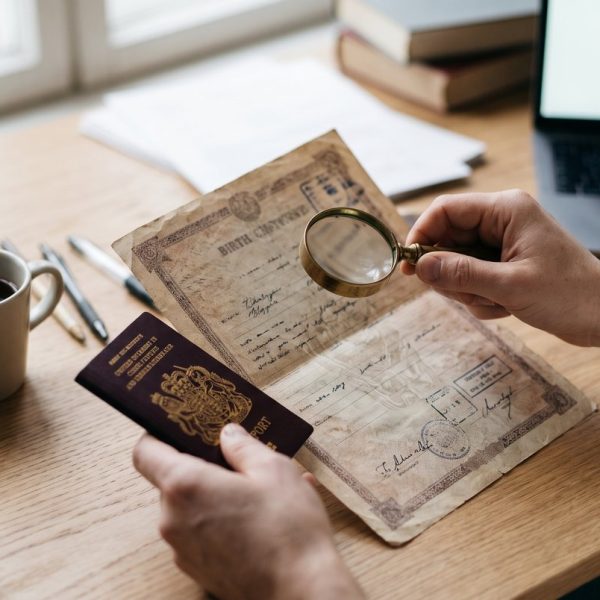
Ask anyone who has moved from Kyiv to Manchester or from Kharkiv to Toronto, and they will tell you the same story: the hardest part of their paperwork was not the translation itself, but the spelling of their own name. One office wrote Oleksandr, another Aleksandr, a third Olexander. Ukrainian transliteration sounds like a technical footnote, yet it is the detail that most often stalls visa applications, university enrolments and bank checks. This guide explains why it happens and how to get it right the first time.
Why Ukrainian transliteration causes so many problems
Ukrainian and Russian both use the Cyrillic alphabet, but not the same version of it. Ukrainian has letters such as і, ї, є and ґ that Russian does not use, while Russian has ы, э and ъ. A name like Сергій in Ukrainian becomes Serhii, whereas the Russian form Сергей becomes Sergei or Sergey. Same person, same family, sometimes even the same birth certificate issued in Soviet times, and suddenly three possible spellings.
On top of the language difference, several transliteration systems coexist. Ukraine adopted an official national standard in 2010, which is used for passports. Older documents, Soviet era certificates and records issued in Russian follow different conventions. The overview of the romanization of Ukrainian on Wikipedia shows just how many systems have been in use over the years.
The passport rule: match what is already official
For anyone translating documents for official use abroad, there is one golden rule. If the person holds a foreign passport, the name in the translation should match the Latin spelling in that passport, letter for letter, even if a modern transliteration table would produce something different. Immigration officers, registrars and employers compare documents side by side. A single letter of difference between the passport and a translated birth certificate can trigger a request for a statutory declaration or a full resubmission.
A professional translator will usually add a short note when the passport spelling differs from the standard transliteration, so the receiving authority can see that the choice was deliberate. If the person has no passport yet, the translator should apply the current official standard for the source language and state which system was used.
Russian transliteration and mixed language records
Many families from Ukraine, Belarus and Kazakhstan hold documents in both Ukrainian and Russian. A birth certificate from the 1980s may be entirely in Russian, while a marriage certificate from 2015 is in Ukrainian. Russian transliteration follows its own set of rules, and the romanization of Russian also varies between scholarly, passport and journalistic systems.
The temptation is to standardise everything to one spelling. That is the right instinct for the person's own name, which should stay consistent across the whole file. For place names, institutions and the names of parents or officials, however, the translator should follow the language of each document, so the translation remains faithful to the original. The difference between the two languages is more than cosmetic, as this look at the complexity of Russian document translation services explains in more detail.
Patronymics, surnames and gendered endings
Eastern Slavic names have three parts: a given name, a patronymic derived from the father's name, and a surname. Western forms often have only two fields, so it is common to see the patronymic dropped or squeezed into a middle name box. In a certified translation, the patronymic must stay. It is part of the legal name on the source document, and leaving it out creates a mismatch.
Surnames add another twist. Many have feminine and masculine forms, such as Kovalenko staying the same for both, but Petrov becoming Petrova. When a translator handles the documents of a whole family, each person's surname should appear in the correct form for that person, and consistently in every certificate.
Fonts, lookalike letters and scanned documents
Old Soviet certificates were often handwritten in ornate script, and some Cyrillic letters look almost identical to Latin ones while sounding completely different. The Cyrillic р is an r, the н is an n, and the в is a v. Misreading these in a faded scan is a classic error. For a deeper look at this problem, the article on Cyrillic names, fonts and lookalike letters in translation offers useful examples.
Always provide the clearest possible scan, in colour, with every stamp and margin note visible. If a letter is genuinely illegible, a good translator marks it as such instead of guessing.
A practical checklist before you order a certified translation
Gather all the documents you will need for the same application, and send them together, so one translator can keep the spelling consistent. Include a copy of your passport photo page as a spelling reference. Tell the translator which country and which authority the translation is for, because requirements differ between the United Kingdom, Canada and the European Union. Ask for the transliteration system to be stated where it matters, and check the draft carefully before it is certified.
Handled with care, Ukrainian transliteration stops being a source of stress and becomes just another detail done properly. The goal is simple: one person, one spelling, on every page of every document.